
Description
Crimson Evolution And Rising Feminine Depth In A Juvenile Female Grand Eclectus
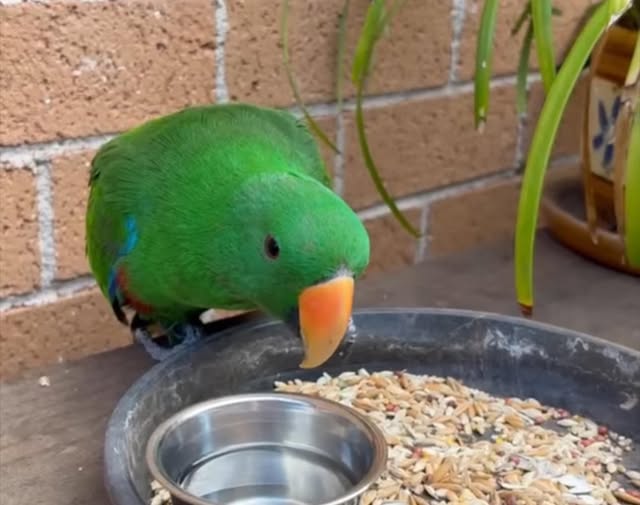
Marivelle stands at a meaningful turning point in the juvenile female Grand Eclectus development cycle—where her colors deepen, her presence grows more assured and her emotional clarity matures into a powerful expression of feminine Eclectus identity. Her plumage, once soft and airy in infancy, now unfolds with layers of red richness. Under daylight, her feathers reveal a breathtaking combination of deep crimson, velvet maroon and faint violet undertones that shimmer subtly when she moves.
This stage marks one of the most visually dramatic transformations in Eclectus growth. Marivelle’s new feathers erupt with density and shine, forming structured rows that lie closer to the body. Each new layer adds a note of maturity, presenting a visual harmony between brightness and depth. As she rotates her head or spreads her wings, the gradients within her plumage display the complexity that makes Grand Eclectus females some of the most beautiful parrots in the world.
Her facial structure begins to refine during this phase. Soft curves along her cheeks give way to more defined contours, and her eyes—bright, rounded and full of awareness—express a growing sense of personal identity. The innocence of her baby months remains, but now it blends with an emerging strength, forming a personality that feels intuitive, perceptive and curious.
Although her plumage captures attention, her presence captivates even more deeply. She carries herself with calm elegance, moving through her space with balanced steps and thoughtful inspection. Her posture reflects stability rather than uncertainty, and each gesture reveals her increasing comfort within a structured environment. Marivelle presents herself as a bird both gentle and grounded—a combination many families love in juvenile Eclectus females.
Internal link: How to Socialize a Shy Eclectus Parrot
https://exoticbirdsfarm.online/socialize-shy-eclectus-parrot/
Emotional Development And Expanding Insight In This juvenile female grand eclectus
Refined Emotional Interpretation
Marivelle’s emotional intelligence grows stronger each week. She interprets vocal tone, facial expression and physical gestures with accuracy, adjusting her behavior accordingly. When someone approaches her with warmth, she lowers her feathers and softens her gaze. If she senses excitement, her posture shifts subtly, showing alertness without anxiety.
Calm Feminine Presence Emerging Through Steady Awareness
Her femininity expresses itself not through fragility but through intuitive steadiness. She reacts with composure, rarely making abrupt movements. Her awareness feels layered, as though she studies her environment before responding. This kind of measured emotional control sets a foundation for long-lasting relational harmony.
Affectionate But Selective Connection Style
Unlike overly social juveniles who seek attention constantly, Marivelle offers affection with intention. She chooses moments to nuzzle gently or rest near her caregiver. These selective gestures reflect sincerity and depth, making her companionship especially meaningful.
Training Growth And Improving Physical Coordination
Step-Up Development Marked By Grace And Purpose
Marivelle practices the step-up command with a level of precision uncommon in younger birds. She lifts her foot confidently and places it with smooth alignment. Each repetition strengthens her trust and supports the connection between body awareness and cognitive learning.
Perch Movement For A juvenile female grand eclectus
Her coordination continues improving as she navigates perches of varying shapes and heights. She adjusts balance by shifting her wings slightly and engaging her leg muscles with measured effort. These training exercises contribute to refined movement and increased physical elegance.
Vocal Awareness And Early Sound Memory
Although not yet a talker, she engages with rhythm patterns. When she hears repeated notes, she tilts her head and narrows her focus. A few soft, low murmurs emerge as she tests her voice. These early experiments show promising potential for future vocal expression.
Daily Routine Supporting Growth, Stability And Cognitive Engagement
Morning Activation And Crimson Brightening
Morning light enhances the richness of her feathers. She begins her day with gentle wing extensions and body stretches that prepare her muscles for balanced movement. The warm sunlight sharpens the contrast between her deeper maroon tones and the brighter crimson layers forming around her face.
Midday Exploration And Cognitive Expansion
During midday, Marivelle enjoys activities designed to stimulate her growing mind. She explores textured objects, rotating them gently with her beak. Sensory boards introduce new patterns, while light climbing structures deepen her coordination. This type of cognitive engagement supports mental resilience and memory formation.
Afternoon Training For A juvenile female grand eclectus
Afternoons provide ideal conditions for training. The calm environment helps her focus on commands, auditory cues and gentle repetition. She performs step-up sequences with composure and engages in early voice practice with soft interest.
Evening Bonding And Emotional Integration
As the day slows, Marivelle enters a peaceful emotional state. She responds positively to soft petting, particularly around her cheeks and neck. Evening routines reinforce emotional connection, helping her feel safe and deeply bonded.
Developmental Milestones Reflecting Juvenile Feminine Maturity
Deepening Crimson Tone
Her feathers darken in the most elegant way, forming a tapestry of rich shades that signal her transition to near-adolescent coloration.
More Controlled Posture
Her standing position becomes stable and symmetrical. Perched or walking, she maintains balance gracefully.
Strengthening Cognitive Pathways
Marivelle learns cues more quickly now. She recognizes familiar sounds and begins associating them with actions or rewards.
Emerging Independence
While she enjoys companionship, she also explores quietly on her own, revealing confidence and autonomy.
Nutrition Supporting Color Density, Emotional Strength And Physical Development
Daily Diet For Rich Crimson Formation
• Eclectus-formulated pellets
• Fresh leafy greens: Swiss chard, romaine, baby bok choy
• Beet slivers, carrot curls, pumpkin strands
• Red berries, mango, plum, papaya
• Sprout blends suited for juveniles
• Light nut fragments for energy
Enrichment-Based Nutrition
• Warm vegetable mash with gentle spices
• Berry purée
• Soft fruit cubes for beak conditioning
Physical And Emotional Enrichment Tools
• Rope vines with soft resistance
• Multi-textured stepping platforms
• Gentle wobble boards
• Early foraging puzzles
• Sound-based enrichment toys
External link about eclectus:
https://en.wikipedia.org/wiki/EclectusVeterinary Evaluation And Juvenile Health Confidence
Marivelle’s veterinary results confirm excellent overall health:
• Clear lungs
• Smooth hydration levels
• No abnormalities in feather growth
• PBFD/Polyoma negative
• Calm examination behavior
• Ideal juvenile weight
Included With Purchase
• DNA certificate
• Hatch paper
• Veterinary file
• Feeding guide
• Juvenile behavioral notes
• Export certification
⭐ Buyer Locations Actively Searching for Grand Eclectus Parrots
Buyers searching for a juvenile female Grand Eclectus parrot often prioritize emotional balance, growing independence, and a bird that adapts smoothly to structured routines. Because Marivelle is seven months old, interest commonly comes from keepers who want a parrot past the early baby stage while still receptive to calm guidance.
Across North America, buyer activity appears around Palo Alto Residential Gardens, California, where quiet, low-stimulation homes support visually attentive Eclectus parrots. Meanwhile, searches also arise from Chapel Hill Woodland Neighborhoods, North Carolina, where experienced caretakers value juveniles known for thoughtful behavior. In Canada, interest becomes visible near Prince Edward County Upper Residential Areas, Ontario, particularly among keepers attentive to diet precision and environmental consistency.
Within the United Kingdom, buyer intent develops in Bourton-on-the-Hill Countryside Edge, Gloucestershire, where Eclectus parrots are often selected by owners familiar with species-specific care. At the same time, interest across continental Europe grows in Palmela Serra Foothills (Portugal), Pienza Outer Slopes (Italy), Staufen Forest Quarter (Germany), Sallanches Alpine Edge (France), and Rupit Interior Highlands (Spain). Buyers in these regions often compare maturity level, composure, and routine tolerance.
Additionally, searches originate from Sigtuna Residential Belt (Sweden), Bloemendaal Woodland Estates (Netherlands), Škofja Loka Upper Valley (Slovenia), La Roche-en-Ardenne Forest Fringe (Belgium), Modra Vineyard Hills (Slovakia), and Muralto Lakeside Rise (Switzerland). Consequently, demand remains steady across regions known for ethical parrot ownership.
Beyond Europe, buyers in Leura Upper Blue Mountains, New South Wales (Australia) and Arrowtown Valley Edge, Otago (New Zealand) often search for Grand Eclectus parrots suited for calm, long-term homes. Meanwhile, interest in the Middle East appears from Al Barari Inner Garden Estates (UAE), Abu Al Hasaniya Residential Zone (Kuwait), and Umm Salal Northern District (Qatar), where welfare transparency and documentation clarity remain priorities.
In Asia, buyer searches also originate from Karuizawa Woodland Communities (Japan), Upper Bukit Timah Nature Belt (Singapore), and Tai Tam Hillside (Hong Kong). In these markets, juvenile female Grand Eclectus parrots are valued for emotional awareness, visual sensitivity, and structured companionship.
⭐ Frequently Asked Questions — Grand Eclectus (Juvenile Female Stage)
How does a juvenile female Grand Eclectus typically behave?
At this stage, independence develops gradually. Therefore, responses often appear calm, observant, and deliberate.
Are seven-month-old female Grand Eclectus parrots sensitive to change?
They can be. However, gradual adjustments help maintain confidence and emotional stability.
How does routine affect a juvenile female Grand Eclectus?
Routine plays a major role. Moreover, consistent feeding and lighting schedules reduce stress responses.
What type of interaction works best at this age?
Intentional, calm interaction works best. Consequently, trust develops without overstimulation.
Is Marivelle suitable for long-term companionship homes?
Absolutely. With structured care and patience, she can mature into a steady, emotionally balanced companion.
Why Marivelle Makes A Remarkable Juvenile Companion
Marivelle blends beauty, emotional clarity, intelligence and feminine grace. Her gentle temperament makes her easy to bond with, while her emerging strength ensures she adapts smoothly to new surroundings. She brings warmth, stability and elegance to any environment and grows into a companion deeply connected to her caregivers.
She offers:
• Extraordinary crimson beauty
• Thoughtful emotional presence
• Steady, graceful body coordination
• Intelligent responsiveness
• Long-term relational depth
Her partnership enriches every home she joins.
Transition Preparation And Arrival Experience
Marivelle’s transition includes:
• Gentle crate-familiarization exercises
• Noise desensitization
• Multi-texture perch acclimation
• Emotional-softening routines
Arrival kit includes:
• Feeding guide
• Daily schedule outline
• Juvenile training tips
• Trust-building instructions
https://exoticbirdsfarm.online/blog/grand-eclectus-female-development-guide/
https://www.thesprucepets.com/eclectus-parrot-profile-390535


Reviews
There are no reviews yet.