

Complete Guide to Caring for Baby Parrots
A complete guide to caring for baby parrots is essential for anyone raising, adopting, or temporarily caring for a young parrot. Baby parrots are fragile, highly dependent, and emotionally impressionable. The care they receive in their earliest weeks and months directly shapes their physical health, confidence, behavior, and long-term wellbeing. Small mistakes during this stage can lead to serious health issues or lifelong behavioral challenges, while proper care creates calm, trusting, and resilient adult parrots.
This complete guide to caring for baby parrots covers every critical area: feeding, warmth, hygiene, development, emotional bonding, safety, and preparing for the next life stages.
Why a Complete Guide to Caring for Baby Parrots Matters
Baby parrots are not simply “small birds.” They are developing individuals whose:
- Immune systems are immature
- Digestive systems are sensitive
- Emotional regulation is undeveloped
- Survival depends entirely on caregivers
Because of this, caring for baby parrots requires structure, precision, and emotional awareness.
A complete guide to caring for baby parrots helps to:
- Prevent feeding-related emergencies
- Support healthy growth and brain development
- Build early trust and emotional security
- Avoid future behavioral problems
- Ensure ethical, responsible care
These principles are consistently emphasized in professional Parrot Care Guides.
Understanding Baby Parrot Development Stages
Before providing care, it is important to understand how baby parrots develop.
Hatchling Stage (0–2 Weeks)
At this stage, baby parrots:
- Cannot regulate body temperature
- Require frequent feeding
- Are extremely vulnerable to infection
Care focuses on warmth, hygiene, and precise feeding.
Nestling Stage (2–5 Weeks)
During the nestling stage:
- Growth accelerates
- Feeding volume increases
- Coordination improves gradually
Consistency becomes essential for healthy development.
Fledgling Stage (5–10+ Weeks, Species Dependent)
Fledglings:
- Begin exploring movement and balance
- Start showing curiosity
- Rely on reassurance as confidence builds
Care shifts toward encouraging exploration while maintaining safety.
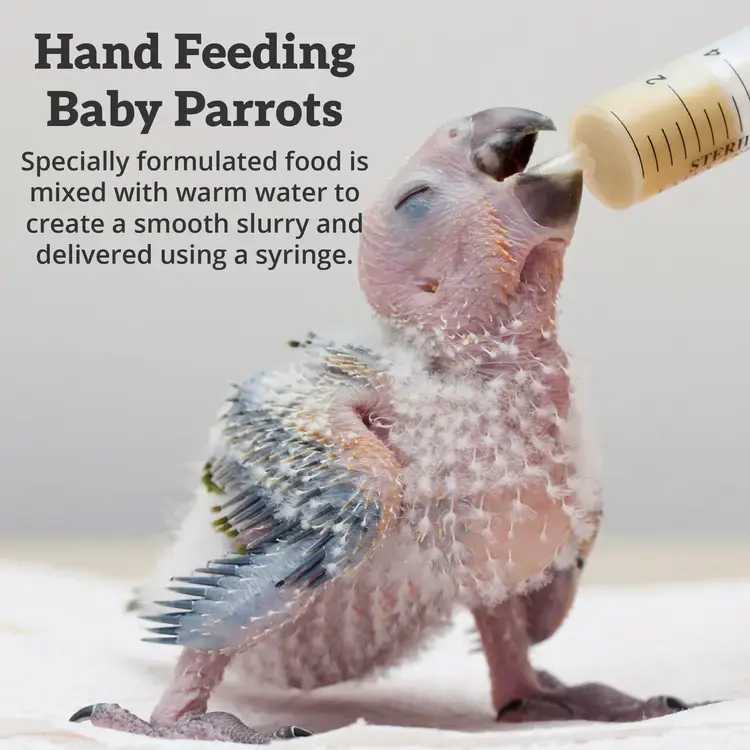
Feeding: The Foundation of Baby Parrot Care
Why Feeding Is So Critical
Feeding is not only nutrition—it is comfort, trust, and survival.
Errors in feeding can cause:
- Crop burns
- Aspiration pneumonia
- Malnutrition
- Developmental delays
For this reason, feeding practices must follow strict guidelines, as detailed in Baby Parrot Feeding Guide resources.
Choosing the Right Feeding Formula
Only use high-quality, species-appropriate commercial hand-feeding formula.
Never use:
- Homemade mixtures
- Baby food
- Milk products
Improvised diets are dangerous and often fatal.
Formula Preparation and Temperature
Safe preparation includes:
- Fresh formula for each feeding
- Sterilized tools
- Correct temperature (typically 39–41°C / 102–106°F)
Formula that is too hot or too cold can cause serious injury.
Feeding Frequency by Age
Although species vary, general guidelines include:
- Hatchlings: every 2–3 hours
- Nestlings: every 4–6 hours
- Older chicks: 3–4 times daily
- Fledglings: gradually reduced as solid foods are introduced
Monitoring crop emptying between feeds is essential.
Warmth and Environment for Baby Parrots
Temperature Control
Baby parrots cannot regulate body heat.
Depending on age, they require:
- Brooders or warm enclosures
- Stable temperatures
- No drafts or sudden changes
Temperature stability directly affects digestion and immunity.
Clean, Safe Housing
Housing must be:
- Easy to sanitize
- Dry and clean
- Free of loose threads or hazards
Poor hygiene is one of the leading causes of illness in baby parrots.
Hygiene and Health Protection
Why Cleanliness Is Non-Negotiable
Baby parrots have developing immune systems.
Essential hygiene practices include:
- Washing hands before handling
- Sterilizing feeding tools
- Cleaning surfaces regularly
- Discarding leftover formula
Bacterial growth happens quickly in warm environments.
Monitoring Health Daily
Caregivers should check:
- Weight gain
- Crop emptying
- Droppings
- Activity levels
Any sudden change requires immediate attention.
Emotional Care and Bonding in Baby Parrots
Feeding Builds Emotional Security
Calm, predictable feeding creates trust.
A baby parrot that feeds calmly is learning:
- Humans are safe
- Needs are met consistently
- Stress resolves predictably
This emotional foundation influences lifelong behavior.
Gentle Handling Without Overhandling
Handling should be:
- Calm
- Purposeful
- Brief
Excessive handling can cause overstimulation and future dependency.
Understanding this balance aligns closely with How Parrots Bond With Humans.
Preventing Over-Bonding Early
One of the most overlooked aspects of caring for baby parrots is preventing emotional over-dependence.
Over-bonding occurs when:
- One person provides all comfort
- Independence is discouraged
- Separation is avoided
Healthy care encourages trust and independence, a concept tied closely to Understanding Parrot Social Dynamics.
Weaning: A Critical Transition Stage
Why Weaning Must Be Gradual
Forcing weaning often leads to:
- Anxiety
- Weight loss
- Feeding disorders
- Long-term behavioral issues
A complete guide to caring for baby parrots emphasizes abundance, not restriction.
Introducing Solid Foods
Offer a variety of:
- Soft vegetables
- Cooked grains
- Sprouted seeds
- Age-appropriate pellets
Allow exploration without pressure while continuing formula feeds.
Developmental Learning in Baby Parrots
Movement and Coordination
Encourage:
- Safe climbing
- Wing stretching
- Balance practice
Never rush flight or independence.
Sensory Exploration
Baby parrots learn through:
- Touch
- Sight
- Sound
Controlled exposure builds confidence without fear.
Understanding Baby Parrot Body Language
Baby parrots communicate discomfort early through subtle cues such as:
- Leaning away
- Freezing
- Feather tightening
Recognizing these signals prevents stress escalation and aligns with Understanding Parrot Body Language education.
Vocal Development in Baby Parrots
Normal Vocal Learning
Baby parrots experiment with sound as part of development.
Responding calmly prevents:
- Attention-driven screaming
- Emotional escalation
Sound learning is discussed further in Understanding Parrot Vocal Behavior.
Preparing the Home for Baby Parrot Care
Safe Spaces
Homes should be:
- Quiet but not isolated
- Free from fumes and hazards
- Predictable in routine
Environmental preparation plays a major role in emotional stability.
Routine Establishment
Predictable schedules:
- Reduce anxiety
- Improve sleep
- Support digestion
Routine guidance aligns closely with Setting a Daily Parrot Routine.
Common Mistakes When Caring for Baby Parrots
- Feeding incorrect temperatures
- Poor hygiene
- Overhandling
- Forcing weaning
- Encouraging dependency
- Reacting emotionally to vocalization
Most baby parrot emergencies are preventable.
Long-Term Impact of Proper Baby Parrot Care
Baby parrots raised correctly are more likely to:
- Trust humans calmly
- Develop emotional resilience
- Avoid chronic behavioral issues
- Adapt easily to change
Ethical breeders and families offering Exotic Birds for Sale increasingly prioritize education on baby parrot care to ensure lifelong success.
External Welfare Insight
Avian veterinary and behavioral research consistently shows that early care determines adult outcomes. Educational sources such as avian behavior research publications emphasize feeding accuracy, hygiene, routine, and emotional balance as the pillars of successful baby parrot care.
A complete guide to caring for baby parrots is therefore a responsibility—not optional reading.