
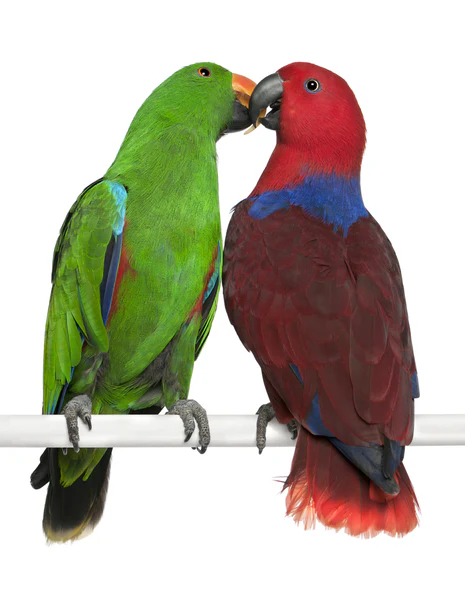

Breeding Eclectus Parrots
Breeding Eclectus parrots is not a casual extension of parrot ownership. It is one of the most complex and responsibility-heavy breeding paths in aviculture. Anyone considering breeding Eclectus parrots must understand that this species operates under very different biological, hormonal, and social rules compared to most parrots.
Eclectus parrots evolved with an unusual mating system, extreme sexual dimorphism, and heightened sensitivity to environment, diet, and stress. Successful breeding depends far more on management, ethics, and restraint than on forcing reproduction. This guide explains how Eclectus parrots breed naturally, what conditions support ethical breeding, common mistakes that cause failure, and why not every healthy pair should ever be bred.
Understanding Natural Breeding Behavior in Eclectus Parrots
A Unique Reproductive Strategy
Eclectus parrots evolved a rare system known as polyandrous mating, where one female may mate with multiple males in the wild. This evolutionary pressure shaped:
- Strong female dominance
- High selectivity in nesting
- Reduced pair-bond dependency
- Intense competition for nest sites
Understanding natural breeding behavior in Eclectus parrots is critical before attempting captive breeding.
Why Captive Breeding Is Challenging
In captivity:
- Space is limited
- Mate choice is restricted
- Environmental cues are artificial
As a result, many captive breeding issues stem from conflict between natural instincts and artificial conditions.
Ethical Considerations Before Breeding Eclectus Parrots
Breeding Is Not Always Appropriate
Breeding should never be attempted simply because:
- You own a male and female
- The birds are mature
- Hormonal behavior is present
Ethical breeding requires:
- Long-term planning
- Proper facilities
- Veterinary support
- Commitment to offspring placement
Understanding ethical responsibility in breeding Eclectus parrots protects both parents and chicks.
Overbreeding Causes Harm
Chronic breeding attempts can lead to:
- Female exhaustion
- Egg binding
- Hormonal disorders
- Feather damage
- Behavioral instability
Breeding should be limited, intentional, and monitored.
Choosing Suitable Breeding Pairs
Age and Physical Maturity
Eclectus parrots should never be bred young.
Recommended minimums:
- Females: 4–5 years
- Males: 3–4 years
Early breeding increases risk of:
- Poor egg quality
- Weak chicks
- Parental stress
This highlights age requirements for breeding Eclectus parrots.
Temperament Compatibility Matters More Than Sex
A male and female that tolerate each other is not the same as a compatible breeding pair.
Signs of compatibility include:
- Calm proximity
- Respectful distance
- Lack of chasing or intimidation
Forced pairings often fail or lead to injury.
Housing and Environment for Breeding Eclectus Parrots
Space Is Non-Negotiable
Breeding Eclectus parrots require:
- Large aviaries
- Multiple feeding stations
- Visual escape options
Small cages dramatically increase aggression, especially from females.
This supports proper housing for breeding Eclectus parrots.
Nest Box Considerations
Nest boxes should:
- Be vertical and deep
- Mimic natural hollow dimensions
- Allow the female to feel hidden and secure
However, nest boxes should only be introduced intentionally—not left permanently, as they trigger hormones.
Understanding nesting requirements for Eclectus parrots prevents chronic hormonal stress.
Diet and Nutrition for Breeding Eclectus Parrots
Nutrition Is the Foundation of Breeding Success
Poor diet is the #1 cause of failed Eclectus breeding.
Breeding birds require:
- Increased fresh vegetables
- Sprouts and legumes
- Adequate but controlled protein
- Calcium from whole-food sources
Avoid:
- Synthetic vitamin supplements
- Excess pellets
- High-fat seeds
This explains why diet is critical when breeding Eclectus parrots.
Calcium and Egg Health
Female Eclectus parrots are prone to calcium imbalance.
Support egg formation with:
- Dark leafy greens
- Broccoli
- Sprouted legumes
Improper calcium management increases egg binding risk.
Courtship and Mating Behavior
Female Control Is Normal
In Eclectus parrots:
- Females initiate nesting
- Females control access
- Males approach cautiously
Aggression from females toward males is common if space is inadequate.
Understanding female dominance in Eclectus parrot breeding prevents misinterpretation.
Copulation Is Brief and Subtle
Mating is often quiet and easy to miss. Absence of visible copulation does not mean breeding is unsuccessful.
Egg Laying and Incubation
Clutch Size and Timing
Typical clutch:
- 2 eggs (sometimes 1–3)
Eggs are laid several days apart. Incubation begins after the second egg in many cases.
Incubation Period
Incubation lasts approximately:
- 28–30 days
The female incubates alone. Males provide food.
Supporting proper incubation conditions for Eclectus parrots is essential.
Risks During Breeding
Egg Binding
This is a life-threatening emergency, especially in first-time females.
Warning signs include:
- Lethargy
- Straining
- Sitting at cage bottom
Immediate avian veterinary care is required.
Chronic Hormonal Stress
If breeding cues are not removed post-clutch, females may:
- Lay repeatedly
- Become aggressive
- Suffer calcium depletion
Breeding must always be followed by hormonal recovery management.
Chick Rearing: Parent-Raised vs Assisted
Parent Rearing Is Preferred
Healthy Eclectus parents usually rear chicks well when:
- Stress is low
- Diet is correct
- Human interference is minimal
Parent-reared chicks often develop:
- Better emotional stability
- Stronger social skills
This supports ethical chick rearing in Eclectus parrots.
When Intervention Is Necessary
Human intervention may be required if:
- Chicks are not fed
- Parents abandon the nest
- Health complications arise
Hand-rearing should be done only with experience and veterinary support.
Weaning and Development
Slow, Gradual Weaning Is Essential
Eclectus chicks wean slowly.
Rushing weaning leads to:
- Behavioral insecurity
- Feeding issues
- Long-term anxiety
Understanding proper weaning for Eclectus parrot chicks is critical to ethical breeding.
Common Breeding Mistakes to Avoid
Leaving Nest Boxes Year-Round
This causes chronic hormonal activation.
Over-Supplementing Vitamins
Eclectus parrots are extremely sensitive to vitamin overload.
Ignoring Female Stress Signals
Female behavior always takes priority during breeding.
Avoiding these mistakes supports successful and ethical Eclectus parrot breeding.
When NOT to Breed Eclectus Parrots
Breeding should not be attempted if:
- Housing is limited
- Avian veterinary care is unavailable
- Diet cannot be properly managed
- Offspring placement is uncertain
Not breeding is often the most ethical choice.
Long-Term Responsibility of Breeders
Breeding Does Not End at Hatching
Ethical breeders must:
- Track genetics
- Support buyers
- Accept returns if needed
- Prioritize welfare over profit
Understanding long-term responsibility in breeding Eclectus parrots defines professionalism.
Final Thoughts
Breeding Eclectus parrots is one of the most demanding paths in aviculture. It requires patience, restraint, deep species knowledge, and ethical clarity. These parrots do not respond well to pressure, shortcuts, or convenience-based breeding.
When breeding is done thoughtfully—with proper diet, space, veterinary support, and respect for natural behavior—Eclectus parrots can reproduce successfully and raise healthy chicks. When done poorly, the cost is paid in stress, illness, and suffering.
For many owners, the most responsible decision is not to breed at all. For those who proceed, doing so ethically is not optional—it is the minimum standard.