
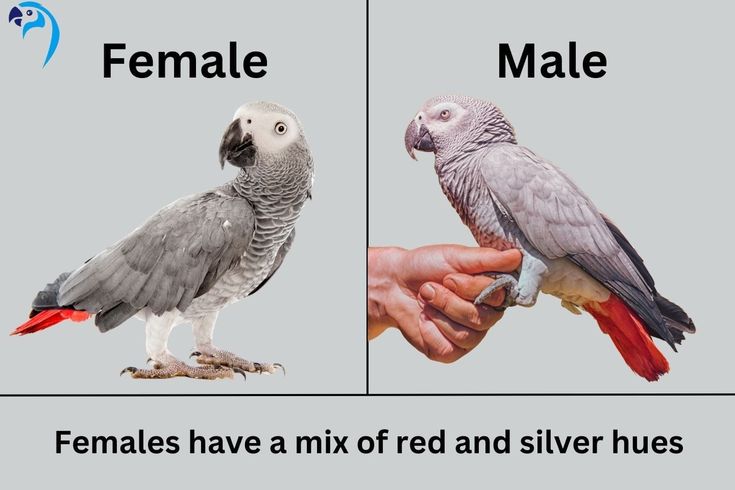

Male vs Female Congo African Grey
The debate around male vs female Congo African Grey is one of the most common—and most misunderstood—topics in African Grey ownership. Many prospective owners hope that choosing a specific sex will guarantee better talking ability, calmer temperament, or easier care. In reality, the differences between male and female Congo African Greys are subtle, situational, and often overshadowed by upbringing and environment.
This article explains what differences truly exist, what is myth, and how sex compares to factors like socialization, routine, emotional stability, and owner behavior. The goal is to help you choose wisely, without unrealistic expectations.
First Reality Check: Congo African Greys Are Not Visually Sexed
No Obvious Physical Differences
Congo African Greys are not sexually dimorphic. This means:
- Males and females look nearly identical
- Size, feather color, and posture overlap significantly
- Visual sexing is unreliable
DNA testing or surgical sexing are the only dependable methods. Any claim that sex can be determined by head shape, tail shade, or stance is speculative.
Therefore, discussions about male vs female Congo African Grey must focus on behavioral tendencies, not appearance.
Temperament: Is One Sex Calmer Than the Other?
The Honest Answer: Individual Personality Matters More
There is no consistent evidence that male or female Congo African Greys are inherently calmer, friendlier, or easier. Temperament is shaped primarily by:
- Early socialization
- Routine consistency
- Emotional environment
- Owner interaction style
That said, long-term keepers sometimes observe mild trends—but these are not guarantees.
Commonly Observed (But Not Universal) Tendencies
Some owners report:
- Males may display more outward confidence
- Females may appear slightly more cautious
However, a well-socialized female is often calmer than a poorly raised male. Environment outweighs sex every time.
This closely aligns with what is seen in Congo African Grey temperament development overall.
Talking Ability: Male vs Female Congo African Grey
One of the Biggest Myths
A widespread belief suggests males talk better than females. In Congo African Greys, this is not reliably true.
Both males and females:
- Have equal vocal anatomy
- Learn speech through context and trust
- Develop vocabulary based on interaction, not sex
Talking ability depends on:
- Emotional security
- Calm repetition
- Meaningful routines
Sex does not determine intelligence, clarity, or vocabulary size. This mirrors findings discussed in Congo African Grey talking ability research and long-term observation.
Bonding Style and Attachment
Differences Are Situational, Not Sex-Based
In the male vs female Congo African Grey discussion, bonding style is often misunderstood.
Both sexes can:
- Form deep bonds with one person
- Bond with multiple people
- Display independence or closeness
What matters most is:
- How early bonding was managed
- Whether independence was encouraged
- How human attention was balanced
Overbonding is a handling issue—not a sex trait.
Hormonal Behavior: Where Sex Differences May Appear
Female Congo African Greys
Females may occasionally show:
- Nest-seeking behavior
- Guarding of cage corners or bowls
- Increased sensitivity during hormonal phases
These behaviors are usually triggered by environmental cues, not personality shifts.
Male Congo African Greys
Males may show:
- Increased vocal display
- Heightened territorial responses toward favored humans
- More visible posturing during hormonal periods
Importantly, hormonal behavior is temporary and manageable with proper environment and routine.
Aggression: Does Sex Play a Role?
Aggression Is Not Sex-Driven
Aggression in Congo African Greys is most often caused by:
- Fear
- Overstimulation
- Boundary violations
- Chronic stress
Sex does not predict aggression. Many so-called “aggressive males” or “moody females” are simply reacting to inconsistent handling or environmental pressure.
Understanding Congo African Grey body language and behavior signs prevents most escalation.
Trainability and Intelligence
Equal Cognitive Capacity
Both male and female Congo African Greys:
- Learn quickly
- Understand complex patterns
- Respond to trust-based training
Differences in trainability usually reflect:
- Motivation
- Emotional comfort
- Training style
Not sex.
Highly intelligent birds often choose whether to cooperate.
Health Considerations
Minor Sex-Specific Awareness
Health risks are largely the same for both sexes. However:
- Females may require careful management of nesting triggers
- Environmental overstimulation can increase hormonal stress
With proper care, sex-related health differences are minimal.
Preventive care matters far more than sex.
Choosing Between a Male or Female Congo African Grey
What You Should Prioritize Instead of Sex
When deciding between male vs female Congo African Grey, prioritize:
- Confidence level
- Socialization history
- Response to calm interaction
- Health records and environment
A balanced bird of either sex will thrive far better than a poorly raised bird chosen solely by sex.
When Sex Might Matter to You
Sex may be relevant if:
- You want to understand potential hormonal behaviors
- You are planning structured breeding under ethical standards
- You prefer predictability during certain life stages
Even then, preparation outweighs preference.
Common Buyer Mistakes
Mistake 1: Assuming Sex Predicts Personality
Correction: Observe the individual bird.
Mistake 2: Choosing Sex Over Socialization
Correction: Prioritize upbringing and environment.
Mistake 3: Ignoring Hormonal Education
Correction: Learn management strategies in advance.
Most disappointment comes from unrealistic expectations, not the bird itself.
Long-Term Reality: Male vs Female Congo African Grey
So, is there a meaningful difference between male vs female Congo African Grey?
Yes—but it is minor, contextual, and far less important than most people believe.
What truly shapes a Congo African Grey’s behavior, talking ability, and companionship quality is:
- How it was raised
- How it is treated
- How stable its environment remains
Sex influences biology.
Care shapes character.
Final Perspective: Choose the Bird, Not the Label
A calm male and a calm female are both possible.
A stressed male and a stressed female are also both possible.
Choosing wisely means looking beyond sex and focusing on the whole bird—its confidence, history, and compatibility with your lifestyle.
That choice matters far more than male or female ever will.