
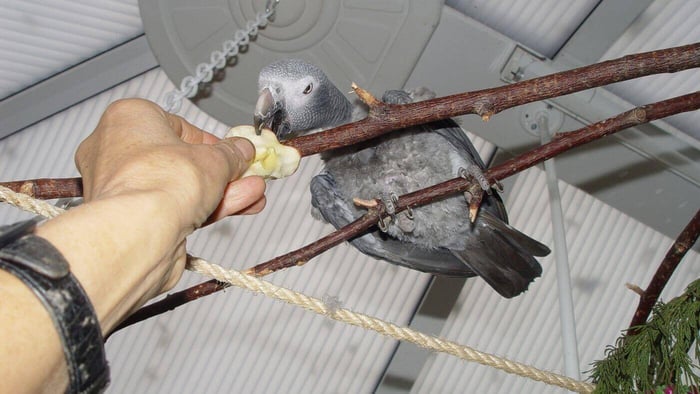

Hand-Raising Congo African Grey Chicks
Hand-raising Congo African Grey chicks is one of the most misunderstood and ethically sensitive practices in modern aviculture. While it is often promoted as the best way to produce “tame” or “talkative” birds, the reality is far more complex. When done incorrectly—or for the wrong reasons—hand-raising can cause lifelong emotional, behavioral, and health consequences that only appear years later.
This article examines hand-raising Congo African Grey chicks from a welfare-first perspective: when it is justified, when it is harmful, what risks are involved, and how ethical breeders balance human involvement with natural development. The goal is clarity, not condemnation—and responsibility, not trend-following.
What Hand-Raising Really Means (and What It Does Not)
Hand-Raising Is Not Automatically Better
Hand-raising refers to removing a chick from its parents and feeding it entirely by humans. However, hand-raising Congo African Grey chicks should never be viewed as a shortcut to tameness or market value.
True social confidence in Congo African Greys comes from:
- Emotional security
- Proper developmental stages
- Predictable, respectful interaction
Not from early human dependency.
Why Hand-Raising Became Popular
Market Demand, Not Biology
Hand-raising gained popularity largely because:
- Buyers want “friendly” birds
- Early-handled chicks appear easier to manage
- Commercial pressure rewards quick bonding
However, Congo African Greys evolved for extended parental care. Interrupting that process too early often trades short-term compliance for long-term instability.
This is especially important when viewed alongside Congo African Grey intelligence explained, where emotional development is tightly linked to early experiences.
The Natural Development of Congo African Grey Chicks
Parent-Raised vs Human-Raised Foundations
In natural or parent-assisted rearing, chicks learn:
- Species-appropriate communication
- Emotional regulation
- Social boundaries
- Confidence through gradual independence
These lessons cannot be fully replicated by humans—no matter how skilled or well-intentioned.
When Hand-Raising May Be Ethically Justified
Limited, Welfare-Driven Scenarios
Ethical aviculture recognizes that hand-raising Congo African Grey chicks may be necessary in specific situations, such as:
- Parental abandonment
- Injury or illness of parent birds
- Failure to feed
- Proven risk to chick survival
In these cases, hand-raising is a rescue intervention, not a production choice.
Major Risks of Hand-Raising Congo African Grey Chicks
1. Improper Emotional Attachment
Chicks raised entirely by humans may:
- Bond excessively to one person
- Fail to self-soothe
- Struggle with independence
This often leads to behaviors later associated with why Congo African Greys develop separation anxiety.
2. Poor Species Identity
Without sufficient exposure to adult Greys, hand-raised chicks may:
- Misinterpret social cues
- Develop inappropriate bonding behaviors
- Struggle to communicate naturally
This can create confusion that persists into adulthood.
3. Long-Term Behavioral Instability
Many behavioral problems seen in adult Greys trace back to early over-handling, including:
- Chronic screaming
- Fear responses
- Aggression during hormonal periods
These issues often surface years after hand-raising, making the connection easy to miss.
4. Health and Immune Risks
Improper hand-feeding techniques increase risk of:
- Aspiration
- Digestive imbalance
- Weakened immune development
Even experienced feeders acknowledge that human error during early development carries serious consequences.
This risk links directly to common health problems in Congo African Greys.
The Myth of “Tamer” Hand-Raised Birds
Calm Confidence vs Learned Dependence
Hand-raised chicks often appear calm early because:
- They have no alternative attachment
- They depend entirely on humans
However, as independence develops, many of these birds:
- Become anxious
- Resist handling
- Develop control-based behaviors
True confidence comes from choice, not dependency.
Parent-Raised With Human Socialization: The Ethical Alternative
A Balanced Development Model
Many experienced breeders now favor:
- Parent-raised chicks
- With controlled, positive human exposure
- Introduced gradually and respectfully
This method supports:
- Healthy species identity
- Emotional resilience
- Easier long-term socialization
It also produces birds better suited for stable homes.
This approach aligns strongly with socializing a Congo African Grey with people best practices.
Weaning: A Critical Ethical Phase
Rushing Weaning Causes Harm
One of the most dangerous practices associated with hand-raising is forced or early weaning. This often leads to:
- Food insecurity
- Anxiety around feeding
- Long-term trust issues
Ethical hand-raising respects the chick’s pace—not market timelines.
The Role of the Breeder’s Intent
Ethics Are Defined by Motivation
Ask one question when evaluating hand-raised birds:
Was this done for the chick’s survival—or for buyer preference?
Ethical breeding decisions prioritize:
- Long-term welfare
- Emotional development
- Responsible placement
This principle is foundational to Congo African Grey breeding basics.
Long-Term Outcomes: Hand-Raised vs Properly Developed Greys
Ethically Raised Birds Tend To:
- Self-regulate emotionally
- Handle change better
- Form healthy, flexible bonds
- Show fewer stress behaviors
Poorly Hand-Raised Birds Often Struggle With:
- Chronic stress
- Hormonal instability
- Social confusion
- Rehoming cycles
The difference may not appear until adolescence or adulthood.
What Ethical Buyers Should Ask
Before purchasing a hand-raised chick, ask:
- Why was hand-raising necessary?
- At what age was the chick removed?
- How was weaning handled?
- Was the chick exposed to adult Greys?
- What support is offered post-placement?
Transparency is a hallmark of ethical practice.
When Hand-Raising Should Be Avoided Entirely
Hand-raising should be avoided when:
- Parents are capable and stable
- Motivation is purely commercial
- Chicks are removed extremely early
- No long-term support is planned
Restraint is often the most ethical choice.
Final Perspective: Ethics Outweigh Convenience
Hand-raising Congo African Grey chicks is not inherently wrong—but it is never neutral. Every decision made during early development shapes the bird’s emotional world for decades.
Ethical aviculture asks not what sells fastest, but what serves the bird best long-term.
Sometimes that means stepping in to save a life.
Often, it means stepping back and letting nature teach first.