
Congo African Grey Legal Requirements by Country
Because Congo African Greys (Psittacus erithacus) are protected globally and subject to strict international conservation rules, understanding the Congo African Grey legal requirements by country is crucial for owners, breeders, and anyone transporting or trading these birds. This guide summarizes key international conventions and national requirements in major regions. It is intended for informational purposes and does not replace official legal advice—you should always consult local authorities in your country before importing, exporting, selling, or transferring ownership.
Global Framework: CITES Protection (Universal Requirement)
CITES Appendix I Status
The Congo African Grey is listed on Appendix I of CITES (Convention on International Trade in Endangered Species of Wild Fauna and Flora). That is the strictest protection level under the treaty and reflects the species’ endangered status.
Key implications of Appendix I listing:
- International commercial trade in wild-caught birds is prohibited.
- Any cross-border movement—even pet travel—requires CITES permits/certificates.
- Captive-bred individuals can be traded, but only with valid permits and traceable documentation.
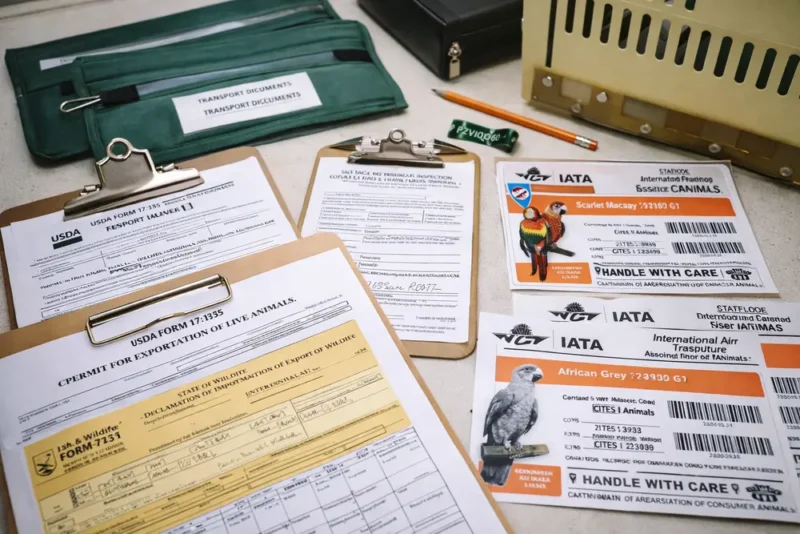
CITES permits are issued by each country’s CITES Management Authority and generally include:
- Export permit from the country of origin
- Import permit from the destination country
- Documented proof of legal origin (e.g., breeder records, microchip/identification)
These are needed whether the bird is being sold, gifted, transported temporarily, or taken abroad with an owner.
Failure to have proper CITES documentation can lead to confiscation, fines, or other penalties under national law in many countries.
Europe (EU and UK)
EU Member Countries
In the European Union, Congo African Greys are treated according to the EU’s implementation of CITES (Annex A). This means:
- All individuals must be accompanied by valid CITES certificates.
- Captive-bred birds require documentation proving captivity and legitimate breeding.
- If birds were already in legal, documented private ownership before the Appendix I change (2017), owners can apply for a CITES Article 10 certificate to legalize possession.
Article 10 certificates are particularly important if you intend to sell, transfer, or move the bird internationally.
United Kingdom (Great Britain and Northern Ireland)
In the UK, CITES controls apply similarly under local legislation. Anyone importing or exporting a Congo African Grey must obtain:
- Import and/or export permits from the UK’s Animal and Plant Health Agency (APHA),
- Supporting CITES documentation from the other country’s authorities.
Penalties for non-compliance may include fines or imprisonment.
United States
In the United States, in addition to CITES paperwork, the US requires:
- USDA imports permits and veterinary export health certificates for imported birds.
- Imported birds (even personal pets) may require quarantine and port inspection.
For pet travel, the U.S. Fish and Wildlife Service (USFWS) may also require:
- CITES permit(s) specifically for the bird’s export out of the U.S.
- Completion of forms for personal pets or repeated border crossings.
Canada
Canada enforces CITES for species like Congo African Greys. Anyone planning to import or export such a bird must have:
- CITES permits valid for both export and import
- Proof of legal origin/ownership
Failing to produce the correct documentation at the border may prevent movement.
India
In India, CITES Appendix I species are regulated under national wildlife law. While trade in wild birds is illegal, captive-bred birds can be moved only with:
- Import permit from the Directorate-General of Foreign Trade (DGFT)
- CITES import permit
- No Objection Certificate (NOC) from the Chief Wildlife Warden
These are in addition to breeder licensing if breeding in captivity.
Domestic licensing requirements vary by state, and unregulated keeping or trade is often illegal without proper permits.
Democratic Republic of Congo (DRC) and Range Countries
Even where the species is native, national protections may be in place. In
2025 the DRC reinforced national protections that criminalize capture, possession, sale, and transport of African Grey parrots to support CITES enforcement and conservation.
Other range states in West and Central Africa may also require permits for any capture, internal trade, or export, particularly for wild birds or parts.
Travel/Temporary Movement
For owners traveling internationally with their bird, most countries require:
- A CITES export and import permit
- International health certificate from a government-approved veterinarian
- Compliance with airline and animal quarantine regulations
Waiting until the last minute risks delays or confiscation at borders.
Domestic Regulation Beyond CITES
CITES governs international trade, but keep in mind:
- Domestic laws also may restrict ownership, sale, or breeding of exotic pets.
- Some countries require wildlife possession permits, exotic animal licenses, or breeder registration.
- Local health, quarantine, or animal welfare laws may apply even to captive-bred birds.
Because regulations vary widely and may be updated often, contact your country’s wildlife agency, customs authority, or CITES Management Authority before moving or trading Congo African Greys.
Practical Checklist (Before Moving or Trading)
- Confirm the bird’s species and status on CITES Appendix I.
- Obtain CITES export permit from current country of residence.
- Secure CITES import permit from destination country (if required).
- Prepare a valid health certificate from an accredited vet.
- Use an officially accepted identification (leg ring/microchip).
- Confirm compliance with customs, quarantine, and airline rules.
Final Perspective: Compliance Protects Birds and People
The Congo African Grey legal requirements by country exist to protect wild populations and regulate responsible ownership. They do more than prevent illegal trade—they establish traceability, animal health assurance, and international cooperation to ensure a future for this remarkable species.
Following these rules is not optional—it is part of ethical care and compliance with international conservation law.