
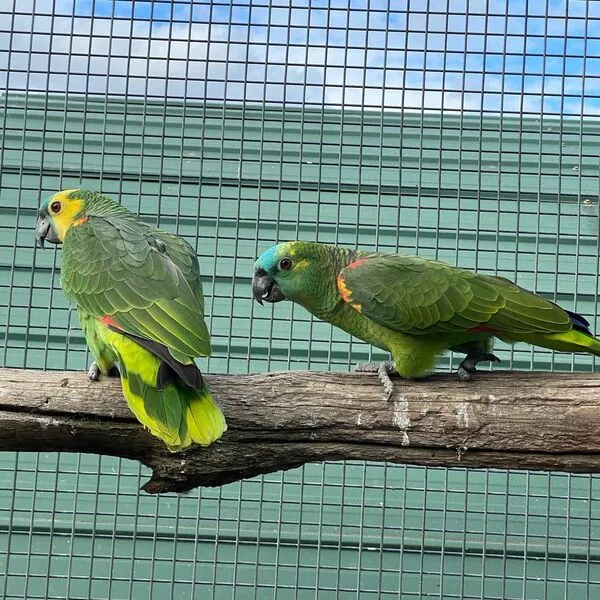

How Bonded Amazon Pairs Communicate
How bonded Amazon pairs communicate is one of the most fascinating—and most misunderstood—aspects of Amazon parrot behavior. Bonded Amazon parrots do not simply live together; they operate as a coordinated social unit. Their communication is constant, subtle, and deeply intentional, involving body language, vocal cues, movement timing, and emotional regulation. When this communication system is understood and respected, bonded Amazons are calmer, more stable, and far less prone to aggression or stress. When it is ignored or disrupted, behavioral issues often follow.
This guide explains how bonded Amazon pairs communicate, how their signals differ from human–parrot communication, what healthy pair interaction looks like, and how caregivers can support—not interfere with—this natural system.
Why Understanding How Bonded Amazon Pairs Communicate Matters
Amazon parrots are highly social birds with strong pair-bonding instincts. Once bonded, their communication becomes pair-centered, not human-centered.
Understanding how bonded Amazon pairs communicate helps to:
- Prevent jealousy and rivalry
- Reduce stress-related aggression
- Support emotional regulation
- Improve household harmony
- Protect the parrot–parrot bond
These principles are essential components of professional Parrot Care Guides, especially in multi-parrot homes.
What Defines a Bonded Amazon Pair?
A bonded Amazon pair is not simply two parrots sharing space.
A true bond includes:
- Mutual choice and proximity
- Coordinated daily behavior
- Emotional co-regulation
- Exclusive communication patterns
Bonded Amazons actively monitor and respond to each other at all times.
These dynamics are explored further in Parrot Pair Social Dynamics.
The Core Ways Bonded Amazon Pairs Communicate
Communication Is Constant and Multilayered
Bonded Amazon pairs communicate through a combination of:
- Body posture
- Feather positioning
- Eye behavior
- Vocal signals
- Movement timing
Most of this communication happens silently.
Body Language Is the Primary Channel
Before any vocalization occurs, bonded Amazons exchange visual cues.
Common signals include:
- Subtle head movements
- Feather tightening or relaxation
- Body orientation toward or away
- Micro-pauses in movement
Understanding these cues aligns closely with Understanding Parrot Body Language.
Vocal Communication Between Bonded Amazon Pairs
Contact Calls Maintain Connection
Bonded Amazons frequently use soft contact calls to:
- Confirm location
- Reassure each other
- Maintain emotional connection
These calls are calm and brief—not loud screams.
Vocal Synchronization
Many bonded pairs:
- Match pitch or rhythm
- Respond immediately to each other
- Reduce vocalization when together
This synchronization reflects emotional regulation, not noise.
Vocal meaning is discussed in more detail in Amazon Parrot Speech Development.
Silent Communication: The Most Important Layer
Movement Timing and Coordination
Bonded Amazon pairs often:
- Move together
- Pause together
- Eat and rest simultaneously
This synchronization reduces stress and increases security.
Proximity as Communication
Distance itself is a signal.
- Close proximity = comfort and trust
- Increased distance = boundary setting
- Sudden separation = stress
Humans should never force proximity changes between bonded pairs.
Emotional Co-Regulation in Bonded Amazon Pairs
One Parrot Calms the Other
When one Amazon becomes alert or anxious, the other often responds with:
- Stillness
- Soft vocalization
- Close proximity
This emotional co-regulation is one of the strongest benefits of pair bonding.
It is also why separating bonded Amazons can be emotionally damaging.
Stress Buffering
Bonded Amazons recover from stress faster because:
- Emotional load is shared
- Signals are immediately understood
- Reassurance is constant
This stability reduces behavioral problems.
Communication During Feeding and Daily Routines
Feeding Is a Coordinated Activity
Bonded Amazons often:
- Approach food together
- Monitor each other while eating
- Share feeding times
Disrupting this rhythm can create tension.
Routine stability supports communication, as explained in Setting a Daily Parrot Routine.
Routine Reinforces Trust
Predictable daily patterns allow pairs to:
- Anticipate events
- Reduce vigilance
- Maintain emotional balance
Unpredictable routines increase stress signals between pairs.
Affection Signals Between Bonded Amazon Pairs
Mutual Preening (Allopreening)
Allopreening is one of the clearest signs of a healthy bond.
It serves to:
- Reinforce trust
- Reduce tension
- Maintain social connection
Humans cannot replicate this behavior.
Shared Resting and Play
Bonded Amazons often:
- Rest side by side
- Play near each other
- Mirror relaxed behavior
These moments strengthen the bond silently.
How Bonded Amazon Pairs Communicate With Humans
Humans Are Observed, Not Central
Bonded pairs communicate about humans as much as with them.
They observe:
- Human tone
- Body language
- Emotional reactions
Then adjust their own behavior accordingly.
This dynamic connects directly to Understanding Amazon Parrot Bonding.
Avoid Becoming a Third “Mate”
One of the biggest mistakes is attempting to insert oneself into the pair bond.
This often causes:
- Jealousy
- Aggression
- Pair tension
Healthy interaction respects the pair first.
Training and Communication in Bonded Amazon Pairs
Training Can Disrupt or Support Pair Communication
Training that favors one bird or creates competition damages communication.
Effective training:
- Is balanced
- Uses equal rewards
- Avoids rivalry
These principles are outlined in Training Amazon Pairs.
Parallel Training Supports Harmony
Training birds side by side with identical expectations:
- Preserves trust
- Reduces jealousy
- Reinforces cooperation
Training should never override pair signals.
Common Misinterpretations of Pair Communication
Avoid assuming:
- Loud vocalization = happiness
- Stillness = calm
- Distance = rejection
Each signal must be read in context.
Misreading communication often leads to unnecessary intervention.
Warning Signs of Communication Breakdown
Signs that pair communication is strained include:
- Persistent avoidance
- One bird guarding resources
- Increased aggression
- Loss of synchronized behavior
These issues usually stem from environmental or routine disruption.
Supporting Healthy Communication Between Bonded Amazon Pairs
Provide Adequate Space
Healthy communication requires:
- Multiple perches
- Duplicate feeding stations
- Visual escape options
Crowding creates tension even in strong bonds.
Minimize Forced Interaction
Allow bonded pairs to:
- Choose proximity
- Set boundaries
- Regulate interaction
Respect preserves communication integrity.
Long-Term Benefits of Healthy Pair Communication
When bonded Amazon pairs communicate effectively, they are more likely to:
- Remain emotionally stable
- Show fewer behavioral issues
- Require less constant human intervention
- Adapt better to change
This is why ethical programs offering Exotic Birds for Sale increasingly prioritize keeping bonded Amazons together.
External Behavioral Insight
Avian behavioral research consistently shows that paired parrots rely heavily on non-vocal communication and emotional co-regulation. Educational sources such as avian behavior research publications confirm that disrupting pair communication increases stress markers and behavioral disorders.
Understanding how bonded Amazon pairs communicate is therefore essential for ethical, long-term care.