
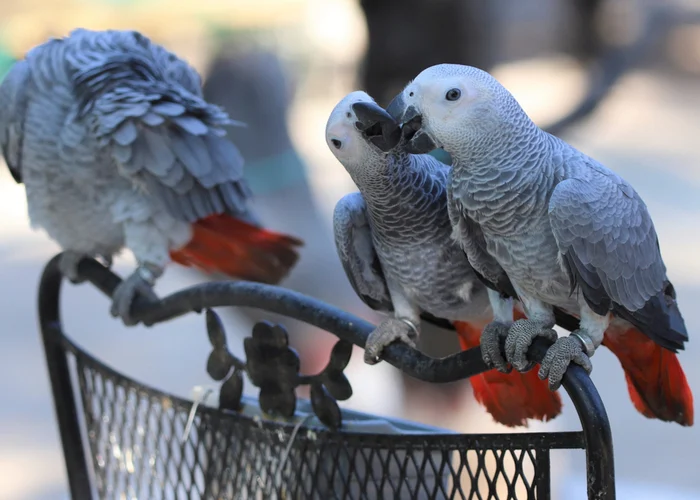

How Congo African Greys Communicate
Understanding how Congo African Greys communicate is one of the most important skills an owner can develop. Congo African Greys are not loud, random, or attention-seeking by nature. Instead, they are highly intentional communicators that use a layered system of sounds, body language, posture, and behavioral context to express needs, emotions, and observations.
Many misunderstandings between humans and Congo African Greys arise not because the bird is difficult—but because its communication signals are overlooked, misread, or unintentionally discouraged. This guide explains how Congo African Greys communicate clearly and consistently, how their communication develops, and how owners can learn to respond in ways that strengthen trust rather than create confusion.
Communication Is Central to Congo African Grey Psychology
Not Just Talking—Understanding
When people think about communication, they often focus on speech. However, how Congo African Greys communicate goes far beyond words. Communication in this species includes:
- Vocal sounds with emotional context
- Body posture and movement
- Feather position and eye behavior
- Timing and repetition of actions
Talking is only one small piece of a much larger system.
Why Congo African Greys Are Such Advanced Communicators
Intelligence and Emotional Awareness Combined
Congo African Greys possess both:
- Advanced cognitive ability
- High emotional sensitivity
This combination allows them to:
- Observe cause and effect
- Associate sounds with outcomes
- Adjust communication based on response
In other words, Congo African Greys do not just make sounds—they expect to be understood.
This directly connects to what is explored in Congo African Grey intelligence explained.
Vocal Communication: More Than Words
Contact Calls and Social Sounds
Congo African Greys naturally use contact calls to:
- Check location of flock members
- Reassure social presence
- Maintain emotional connection
In a home, these calls often appear when:
- A person leaves the room
- The bird hears familiar movement
- Routine changes unexpectedly
Responding calmly reinforces security. Ignoring or shouting back often escalates distress.
Speech and Contextual Language
Speech in Congo African Greys is rarely random. Many birds:
- Use words in appropriate situations
- Match tone to emotion
- Combine sounds creatively
For example, a Congo African Grey may use a specific word to request an action, signal discomfort, or announce routine events.
This is why Congo African Grey talking ability is better measured by context than vocabulary size.
Non-Word Vocalizations
Not all communication uses words. Congo African Greys also use:
- Whistles
- Clicks
- Soft murmurs
- Sharp warning sounds
These vocalizations often carry clear emotional meaning and should not be ignored simply because they are not “talking.”
Body Language: The Most Reliable Communication Channel
Why Body Language Matters More Than Speech
While vocalizations can be learned, body language is instinctive. Understanding posture and movement is essential to understanding how Congo African Greys communicate truthfully.
Birds often communicate discomfort or readiness long before vocal signals appear.
Key Body Language Signals
Common communicative signals include:
- Feather position (relaxed vs tense)
- Body lean (approach vs avoidance)
- Eye focus and movement
- Head and neck posture
These signals often change rapidly, providing real-time emotional feedback.
This closely aligns with Congo African Grey body language and behavior signs education.
Eye Behavior and Facial Signals
Subtle but Meaningful
Congo African Greys use eye behavior to communicate arousal and attention. Rapid eye changes combined with stiff posture may signal heightened emotion—either excitement or discomfort.
Context matters. The same signal can mean different things depending on environment and recent interaction.
Posture and Movement as Communication
Stillness Is Also a Message
Not all communication is active. Stillness can indicate:
- Observation
- Uncertainty
- Emotional overload
A Congo African Grey that freezes is often processing information. Interrupting this moment may increase stress.
Movement patterns—pacing, climbing, repositioning—also convey emotional state.
Behavioral Communication
Actions Speak as Loudly as Sounds
Congo African Greys communicate through behavior such as:
- Refusing interaction
- Repeating specific actions
- Choosing certain locations
For example, a bird that repeatedly moves away from a person is clearly communicating discomfort—even if it remains silent.
Respecting these signals builds trust.
Communication and Emotional State
Emotion Shapes Expression
A Congo African Grey’s communication style shifts based on:
- Emotional security
- Stress levels
- Routine stability
In stable environments, communication tends to be:
- Calm
- Predictable
- Purposeful
In unstable environments, communication may become:
- Repetitive
- Loud
- Withdrawn
This explains why communication issues often accompany anxiety-related topics like why Congo African Greys develop separation anxiety.
How Owners Accidentally Disrupt Communication
Common Mistakes
Owners often unintentionally suppress communication by:
- Punishing vocalization
- Ignoring early body language
- Forcing interaction
- Responding inconsistently
When communication attempts are ignored or punished, Congo African Greys may escalate—or shut down entirely.
How to Encourage Healthy Communication
Step 1: Observe Without Interrupting
Spend time watching posture, timing, and repetition before responding.
Step 2: Respond Consistently
Predictable responses teach the bird that communication works.
Step 3: Respect Refusal Signals
Backing away when a bird signals discomfort reinforces trust.
Step 4: Maintain Routine
Routine stabilizes emotional expression. This strongly supports communication clarity and aligns with a healthy Congo African Grey daily routine.
Communication Changes Over Time
As the Bird Matures
As Congo African Greys age, communication often becomes:
- More refined
- More selective
- More context-driven
Well-supported birds communicate efficiently rather than constantly.
Communication vs Behavior Problems
Many “Behavior Issues” Are Communication Failures
What humans label as:
- Screaming
- Biting
- Withdrawal
is often the result of communication attempts that were misunderstood or ignored.
Learning how Congo African Greys communicate prevents many of these issues before they arise.
Long-Term Benefits of Understanding Communication
Owners who understand communication well often experience:
- Fewer conflicts
- Stronger trust
- Easier training
- Reduced stress behaviors
Communication is the foundation of every successful relationship with a Congo African Grey.
Final Perspective: Communication Is a Partnership
Understanding how Congo African Greys communicate means accepting that communication is two-way. These parrots are constantly sending information about how they feel, what they need, and how they perceive their environment.
When owners listen with patience rather than expectation, communication becomes clear, calm, and deeply rewarding.
A Congo African Grey is always speaking.
The question is whether we are listening.