
Parrot Pair Social Dynamics
Parrot pair social dynamics describe how two parrots interact emotionally, behaviorally, and socially once they form a bond. In nature, parrots rely on pair bonds for survival, cooperation, and emotional regulation. In captivity, these same instincts remain powerful. When pair dynamics are understood and supported, bonded parrots become calmer, more secure, and behaviorally balanced. When misunderstood or disrupted, stress, aggression, and emotional instability can develop.
This guide explains parrot pair social dynamics in depth—how bonds form, how paired parrots communicate, how roles emerge, what healthy dynamics look like, and how humans can support bonded pairs ethically and safely.
Why Parrot Pair Social Dynamics Matter
Parrots are flock animals with strong social intelligence. Pair bonding is not optional for many individuals—it is a core emotional need.
Understanding parrot pair social dynamics helps to:
- Prevent jealousy and aggression
- Reduce stress-related behaviors
- Support emotional regulation
- Improve long-term welfare
- Avoid human–parrot conflict
These principles are central to ethical Parrot Care Guides, especially when keeping more than one parrot.
What Is a Parrot Pair Bond?
A parrot pair bond is a mutual, chosen social relationship between two parrots. It is not simply cohabitation.
A true bond includes:
- Mutual trust and proximity
- Coordinated movement and behavior
- Emotional co-regulation
- Communication exclusivity
Bonded parrots rely on each other in ways humans cannot replace.
How Parrot Pair Social Dynamics Form
Choice, Not Force
Healthy pair bonds form through choice. Forced pairing often fails.
Bond formation depends on:
- Temperament compatibility
- Species compatibility
- Age and developmental stage
- Emotional readiness
Successful bonding cannot be rushed.
Early Experience Shapes Pairing
Parrots with healthy early social exposure bond more easily.
This is why early development and social learning—explored in The Importance of Early Parrot Socialization—play a major role in later pair success.
Communication Within Parrot Pair Social Dynamics
Silent Communication Is Constant
Bonded parrots communicate continuously through:
- Body posture
- Feather positioning
- Eye focus
- Movement timing
Much of this communication is silent but highly precise.
Understanding these cues aligns closely with Understanding Parrot Body Language.
Vocal Coordination
Paired parrots often:
- Call to each other softly
- Synchronize vocal patterns
- Use contact calls for reassurance
This is not noise—it is emotional regulation. Vocal interaction is explained further in Understanding Parrot Vocal Behavior.
Emotional Regulation Between Paired Parrots
Co-Regulation Is a Key Benefit
One of the strongest aspects of parrot pair social dynamics is emotional co-regulation.
Bonded parrots:
- Calm each other during stress
- Recover faster from fear
- Maintain emotional balance when humans are absent
This is why some parrots must live with a companion, as discussed in Benefits of Keeping Bonded Parrots.
Stress Buffering
When one parrot becomes alert or anxious, the other often responds with:
- Proximity
- Soft vocalization
- Stillness
These behaviors reduce stress without human intervention.
Roles Within Parrot Pair Social Dynamics
Complementary Roles
Parrot pairs often develop subtle roles, such as:
- One more alert or observant
- One more exploratory or bold
These roles are fluid, not dominant–submissive.
No Fixed “Leader”
Unlike pack animals, parrot pairs do not operate on rigid hierarchy. Decision-making shifts based on context and confidence.
Misinterpreting this as dominance often leads to human interference that destabilizes the bond.
Affection and Bond Maintenance
Mutual Preening
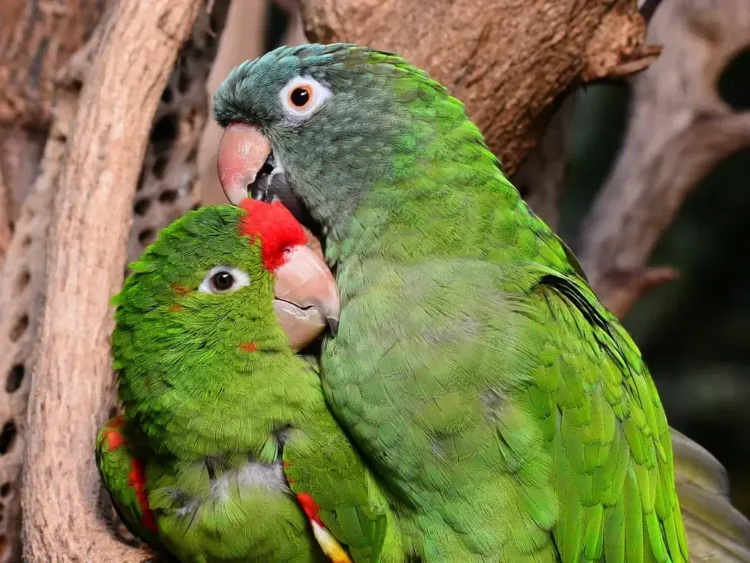
Allopreening (mutual grooming) is one of the clearest signs of a strong bond.
It serves to:
- Reinforce trust
- Reduce tension
- Maintain social connection
Humans cannot replicate this behavior.
Proximity and Synchrony
Bonded parrots often:
- Sit close together
- Mirror movements
- Rest at the same time
These behaviors are emotional anchors within the pair.
Parrot Pair Social Dynamics vs Human Interaction
Why Humans Cannot Replace a Parrot Partner
Even attentive humans cannot:
- Preen correctly
- Communicate continuously
- Provide 24/7 presence
- Mirror instinctive responses
This is why forcing single parrots to rely entirely on humans often leads to over-bonding and distress.
This issue is explored further in Understanding Parrot Social Dynamics.
Healthy Human Boundaries
In paired homes, humans should:
- Avoid competing for attention
- Respect pair time
- Interact calmly and predictably
Healthy bonds flourish when humans support—not replace—the pair.
Common Challenges in Parrot Pair Social Dynamics
Jealousy and Resource Guarding
Challenges may arise around:
- Food bowls
- Favorite perches
- Human attention
These issues are usually environmental, not relational.
Hormonal Periods
During breeding seasons, pair dynamics may intensify.
Signs include:
- Increased protectiveness
- Reduced tolerance of humans
- Heightened vocalization
Managing routine and boundaries is essential during these times.
Supporting Healthy Parrot Pair Social Dynamics
Environment Matters
Healthy pair dynamics require:
- Adequate space
- Multiple feeding stations
- Duplicate toys and perches
- Quiet retreat areas
Crowding creates conflict even in bonded pairs.
Routine Supports Stability
Predictable routines:
- Reduce competition
- Lower anxiety
- Improve emotional balance
This stability aligns closely with Setting a Daily Parrot Routine.
Introducing Training Into Paired Homes
Yes, Paired Parrots Can Be Trained
Training paired parrots is not only possible—it is beneficial.
Training should be:
- Individualized
- Short and calm
- Choice-based
Reward-based methods in Positive Reinforcement Training for Parrots work well when emotional signals are respected.
Avoid Creating Competition
Training sessions should prevent:
- Resource guarding
- Attention rivalry
Separate, parallel sessions often work best.
Species Differences in Pair Dynamics
Cockatoos
- Extremely emotionally bonded
- Highly sensitive to disruption
- Benefit greatly from compatible partners
Species-specific sensitivity is discussed in Understanding Cockatoo Emotions.
African Greys
- Subtle but strong pair bonds
- Quiet co-regulation
- High mutual awareness
Conures
- Energetic and interactive
- Strong social play
- Require clear boundaries
Macaws
- Bold, confident pairs
- Strong physical coordination
- Need space and structure
When Pair Dynamics Become Unhealthy
Warning signs include:
- Persistent aggression
- Fear or avoidance
- One parrot monopolizing resources
- Chronic stress behaviors
These issues require environmental and routine adjustments—not punishment.
Separating Bonded Pairs: Why It’s Risky
Breaking a bonded pair often results in:
- Depression-like withdrawal
- Chronic screaming
- Feather plucking
- Loss of appetite
Separation should only occur for medical or safety reasons and must be handled carefully.
Long-Term Benefits of Healthy Parrot Pair Social Dynamics
Well-supported parrot pairs are more likely to:
- Remain emotionally stable
- Show fewer behavioral problems
- Require less constant human attention
- Adapt better to change
Ethical programs offering Exotic Birds for Sale increasingly prioritize keeping bonded pairs together whenever possible.
External Behavioral Insight
Avian behavioral research consistently shows that socially housed parrots demonstrate better emotional regulation and lower stress markers than isolated individuals. Educational sources such as avian behavior research publications emphasize that pair bonds are protective factors against chronic stress and behavioral disorders.
Understanding parrot pair social dynamics is therefore fundamental to ethical parrot care.