
Description
Unified Pair Presence, Emotional Dialogue & Alexandrine Bonding Harmony
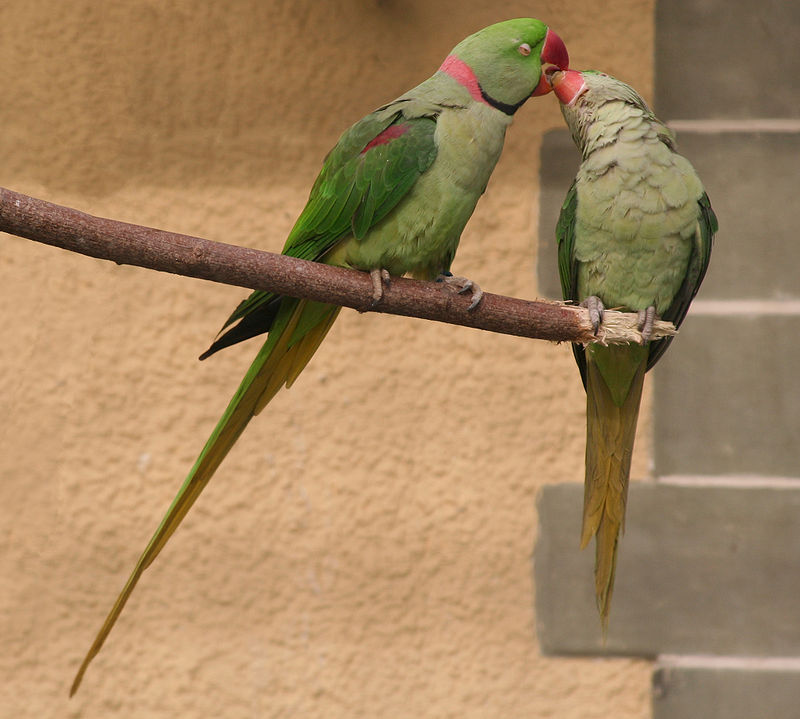
Maelis and Kaela represent the elegant interaction and emotional depth expected of a mature Alexandrine parakeet couple, though their bond is unusually synchronised and expressive for their age. Because they were raised in a cooperative environment with daily pair-conditioning routines, they respond to each other—and to caregivers—with remarkable clarity. Their dynamic blends affection, curiosity and structured communication, creating a rare bond ideal for long-term companionship or responsible breeding programs.
This Alexandrine parakeet couple demonstrates high pair intelligence: they mirror posture, align crest movements, exchange soft vocal notes and perch side-by-side with rhythmic balance. This harmony makes them exceptionally easy to integrate into households or aviary settings requiring emotional stability and cooperative behaviour.
Emerald Dual-Plumage Refinement, Wing Strength & Pair Aesthetic
Maelis — Rich Emerald Depth
His feathers display strong emerald saturation with turquoise undertones, highlighting his genetic strength.
Kaela — Soft Jade & Velvet Layers
Her smooth jade tones complement Maelis’ deeper green, creating a visually refined balance unique to this pair.
Symmetrical Tail Formation
Their tails grow in parallel length and alignment, enhancing their paired silhouette in flight or when perched.
Facial Expression Harmony
Both birds maintain expressive, bright eyes that show attentiveness, emotional contentment and trust.
Calm Pair Communication, Balanced Temperament & Emotional Stability
Shared Crest Language
Their crests lift and lower in synchrony during curiosity, greeting or mild excitement.
Duet Whistle Exchange
Maelis initiates melodic notes; Kaela responds with soft harmonizing tones, producing a refined pair vocalisation sequence.
Mutual Grooming
Kaela smooths Maelis’ cheek line while he preens her wing edges—signs of deep bonding.
Coordinated Perch Motion
They often move from perch to perch as one, demonstrating instinctive pair awareness.
Growing Global Demand for Paired Alexandrines
Families and collectors seeking a bonded Alexandrine parrot pair for sale increasingly inquire about compatible juveniles like Maelis and Kaela. In the United States, strong interest comes from Cleveland, Portland and Jacksonville, while Canadian buyers reach out from Quebec City and Kelowna. Across the United Kingdom, steady demand arrives from Liverpool and Coventry, and Europe shows consistent growth from cities such as Toulouse (France), Parma (Italy), Malaga (Spain), Kavala (Greece), Évora (Portugal), Białystok (Poland), Bregenz (Austria) and Wiltz (Luxembourg). This expanding geographic interest reflects the worldwide appeal of long-lived, emotionally intelligent Alexandrine pairs.
Pair Training Development, Cooperative Learning & Bond Reinforcement
Paired Step-Up Response
Maelis steps forward assertively; Kaela follows with gentle precision.
Shared Recall Sessions
They perform cooperative short flights to a training perch or extended hand.
Dual Object Exploration
They explore enrichment items sequentially, reinforcing curiosity through shared interaction.
Sound Pattern Recognition
Both birds respond to familiar tones with subtle vocal expression and synchronized head movement.
Daily Pair Rhythm, Bond Synchronisation & Environmental Preferences
Morning Greeting
They begin their day with soft duet calls, light wing stretching and synchronized perch stepping.
Midday Exploration
Maelis and Kaela particularly enjoy:
Dual foraging toys
Pair-oriented puzzle trays
Ladder grids
Branch clusters
Evening Bond Reset
They settle close together, smoothing each other's feathers while preparing for rest.
Widening International Export Demand for Alexandrine Couples
Many clients interested to buy an Alexandrine parakeet couple come from diverse global regions. Common export destinations include Waterford (Ireland), Sandnes (Norway), Grundarfjörður (Iceland), Vejle (Denmark), Leiden (Netherlands) and Thun (Switzerland). Demand extends across Oceania to Townsville (Australia) and Invercargill (New Zealand), while Middle Eastern buyers frequently request bonded pairs from Eilat (Israel), Sharjah North (UAE), Mangaf (Kuwait), Mesaieed (Qatar), Jerudong (Brunei), Madinat Isa (Bahrain) and Al Hofuf (Saudi Arabia). Asian interest continues to rise, especially from Yokohama (Japan), Pasir Ris (Singapore) and Discovery Bay (Hong Kong). These patterns show the Alexandrine’s status as a premium, global companion species.
Nutritional Management, Feather Health & Paired Feeding Dynamics
Pellet Foundation
Both birds receive balanced pellets supporting feather strength and metabolic stability.
Vegetable Diversity
They enjoy a rotation of greens, herbs and vegetables that enhance immune resilience.
Controlled Fruit Intake
Occasional fruit provides natural vitamins without overstimulation.
Paired Feeding Rituals
Shared feeding stations encourage calm, cooperative eating behaviour.
Price & Long-Term Value Insights for Alexandrine Couples
Buyers evaluating the Alexandrine parakeet couple price often consider factors such as compatibility, training history, hand-rearing practices, health screening and breeder reputation. A bonded pair offers unique long-term value, especially when both parrots demonstrate synchronized behaviour, emotional stability and strong pair communication. Maelis and Kaela belong to the premium category of Alexandrine pairs, where quality of upbringing, behaviour shaping and pair compatibility create significant lifetime value beyond the initial investment.
Breeder Commitment, Pair Socialization & Behavioural Assurance
As a professional aviary offering a trained Alexandrine parrot pair for sale, we focus on creating emotionally balanced, well-socialized couples prepared for long-term companionship or responsible breeding programs. Maelis and Kaela have been raised with daily handling, structured routines and shared enrichment sessions. Their synchronized behaviours—such as paired perching, duet calls and mutual grooming—show that they have achieved exceptional pair stability. Their social foundation ensures easy adaptation into any well-structured home.
Ideal Home Environment, Compatibility Notes & Owner Suitability
Ideal For:
Families wanting a bonded duo
Breeders seeking compatible pairs
Aviary owners expanding breeding lines
Individuals valuing emotional synchrony
Environment Requirements:
Dedicated interaction time
Spacious enclosure with pair-friendly layout
Consistent routine
Calm, stable home atmosphere
Habitat Setup, Perch Architecture & Pair Comfort Design
Wide Horizontal Cage
Supports cooperative flight exercise and paired climbing.
Paired Perch Layout
Two parallel perches support synchronized movement.
Enrichment Rotation
A mix of textures, puzzle toys and natural branches keep them mentally stimulated.
Bathing Options
Shallow trays or light misting supports feather maintenance and bonding rituals.
Veterinary Screening, Certification & Ownership Documentation
Both Maelis and Kaela undergo:
DNA testing
PBFD & Polyoma screening
Feather symmetry evaluation
Respiratory assessment
Weight & hydration monitoring
Provided Documents:
2 DNA certificates
Veterinary health reports
Feeding charts
Pair training guidelines
Hatch cards
Export Conditioning, Travel Training & Arrival Support
Carrier Familiarization
Paired carriers help maintain calmness during travel.
Arrival Pack
Includes:
Familiar perch texture
Feeding instructions
Transition plan
Pair comfort guide
⭐ Frequently Asked Questions (FAQs)
1. Do Alexandrine parakeet couples bond for life?
While not strictly monogamous in the wild, hand-raised pairs like Maelis and Kaela often develop lifelong bonds when kept in a stable household or aviary environment.
2. Can bonded Alexandrines still bond with humans?
Yes. A well-socialized pair maintains its relationship while bonding individually with caregivers, especially when handled gently and consistently.
3. Are Alexandrine pairs more vocal than single birds?
Paired birds enjoy duet communication, but Alexandrines are not overly loud. Their vocal exchange is soft, rhythmic and usually pleasant.
4. What size enclosure is best for an Alexandrine couple?
A wide, horizontally oriented aviary or spacious cage is ideal to support synchronized movement and give each bird comfortable glide space.
5. Can an Alexandrine couple be kept with other birds?
They can coexist near other species, but pairing them with different parrots inside the same enclosure is not recommended unless supervised.
Internal Link:
https://exoticbirdsfarm.online/blog/alexandrine-parakeet-couple-care-guide
Real Outbound Links:
Alexandrine Parakeet — Wikipedia
https://en.wikipedia.org/wiki/Alexandrine_parakeet
World Parrot Trust Species Profile
https://www.parrots.org/encyclopedia/alexandrine-parakeet
Reviews
There are no reviews yet.