
Understanding Parrot Body Language
Understanding parrot body language is one of the most important skills any parrot owner, breeder, or caretaker can develop. Parrots communicate constantly through posture, feathers, eyes, movement, and subtle behavioral cues. Long before a parrot vocalizes, it is already expressing comfort, fear, curiosity, affection, or stress through body language. When these signals are correctly interpreted, many bites, behavioral problems, and emotional misunderstandings can be completely avoided.
This guide explains how understanding parrot body language helps you recognize emotional states, respond appropriately, and build trust-based relationships that support long-term wellbeing.
Why Understanding Parrot Body Language Is Essential
Parrots are prey animals. Because showing weakness in the wild can be dangerous, parrots rely heavily on non-verbal communication to express discomfort or uncertainty before resorting to defensive behavior.
Understanding parrot body language helps you to:
- Prevent bites and fear responses
- Reduce stress and anxiety
- Improve training success
- Strengthen trust and bonding
- Support emotional stability
These skills are a core part of ethical ownership and are consistently emphasized in professional Parrot Care Guides.
How Parrots Communicate Without Words
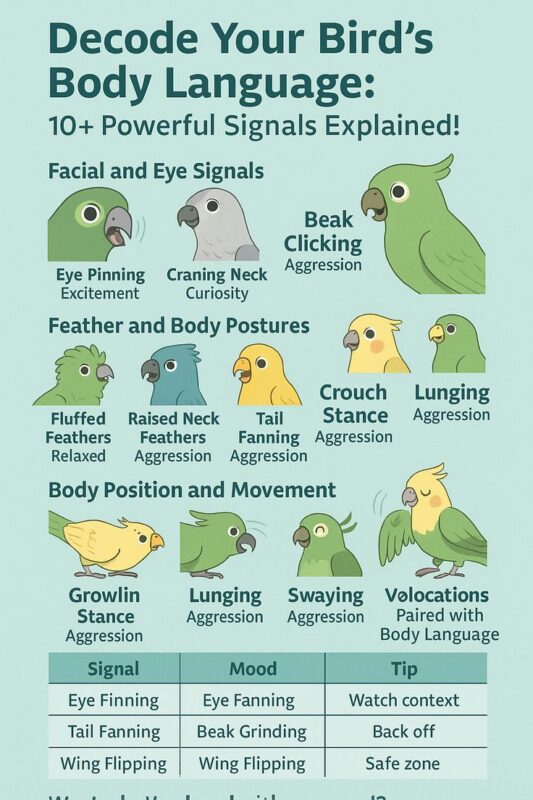
Parrots combine multiple signals at once. A single behavior rarely tells the full story. Instead, parrots communicate through clusters of body language signals that must be read together.
For example, feather position, eye movement, posture, and motion all work together to express emotion. Therefore, understanding parrot body language requires observing the whole bird, not just one feature.
Feather Position and What It Means
Relaxed Feathers
When a parrot’s feathers are slightly fluffed and loose, it usually indicates comfort and relaxation. This often appears during resting, gentle interaction, or calm observation.
However, context matters. A relaxed parrot remains alert and responsive.
Tightly Held Feathers
Sleek, tight feathers can signal alertness, tension, or mild stress. If combined with rigid posture or eye pinning, this may indicate discomfort or overstimulation.
Recognizing this early allows you to pause interaction before escalation.
Excessive Fluffing
If a parrot remains fluffed for long periods and appears lethargic, this may indicate illness rather than emotion. Behavioral interpretation should always consider physical health.
Eye Pinning and Emotional Arousal
Eye pinning—rapid dilation and contraction of the pupils—is one of the most misunderstood aspects of understanding parrot body language.
Eye pinning does not automatically mean aggression. Instead, it signals emotional arousal, which can include:
- Excitement
- Curiosity
- Anticipation
- Fear
- Defensive readiness
Therefore, eye pinning must be evaluated alongside posture, feather position, and movement.
Beak Behavior and Body Language Signals
Gentle Beak Exploration
Soft beak touching or controlled nibbling often indicates curiosity or trust. Many parrots explore their environment through the beak.
This behavior is common in relaxed, emotionally secure parrots.
Beak Grinding
Beak grinding is usually a sign of comfort and relaxation, often occurring before sleep. It is one of the clearest indicators of emotional safety.
Open Beak With Tension
An open beak combined with stiff posture or lunging is a warning signal. This indicates discomfort or a desire for distance.
Understanding parrot body language at this stage can prevent bites by respecting boundaries.
Body Posture and Movement
Upright, Balanced Posture
A parrot standing comfortably with balanced weight usually feels secure and calm. This posture is common during routine interaction.
Leaning Away
When a parrot leans away from a hand or person, it is expressing uncertainty or discomfort. Forcing interaction at this stage damages trust.
Lunging
Lunging is a defensive response, not aggression for dominance. It signals fear or overstimulation and should be met with calm withdrawal, not punishment.
Wing Behavior and Emotional Meaning
Slight Wing Drooping
Mild wing drooping can indicate relaxation, especially after activity. However, context is essential.
Rapid Wing Flicking
Quick wing flicks often signal irritation or impatience. This is a subtle warning that interaction should pause.
Fully Spread Wings
Wing spreading may indicate stretching, excitement, or a defensive display. Observing facial expression and posture clarifies intent.
Tail Movements and Balance
Tail Wagging
Gentle tail wagging often accompanies excitement or anticipation, especially during interaction or feeding.
Tail Flaring
A flared tail combined with eye pinning and stiff posture indicates high emotional arousal and possible defensive behavior.
Understanding parrot body language at this point allows you to create space before escalation.
Vocalization Combined With Body Language
Parrot vocalizations are far easier to interpret when paired with body language.
For example:
- Soft vocalizations + relaxed posture = comfort
- Loud calls + pacing = anxiety or uncertainty
- Silence + rigid posture = stress
This integrated approach connects closely with principles explained in Parrot Vocalization Guide education.
How Stress Shows in Parrot Body Language
Stress often appears before obvious behavioral problems.
Common stress signals include:
- Repetitive movements
- Feather picking or over-preening
- Avoidance behavior
- Reduced vocalization
- Sudden aggression
Many of these signs overlap with emotional challenges discussed in Understanding Parrot Emotions, as body language is often the first indicator of emotional imbalance.
Body Language and Affection
Parrots express affection subtly.
Affectionate body language includes:
- Choosing to sit near you
- Relaxed posture in your presence
- Gentle preening behaviors
- Voluntary interaction
These behaviors align closely with patterns discussed in How Parrots Express Affection, where trust and choice define healthy bonding.
Species Differences in Parrot Body Language
Although many signals are universal, species differences exist.
- Cockatoos tend to be more expressive and exaggerated
- African Greys show subtle, controlled signals
- Conures often display energetic, fast-moving cues
- Macaws use large, visible body movements
Understanding parrot body language should always consider species-specific tendencies.
How Environment Affects Body Language
Environmental stability plays a major role in how parrots express themselves.
A calm environment with predictable routines results in:
- Softer posture
- Fewer defensive displays
- Clearer communication
Routine stability connects strongly with principles outlined in Setting a Daily Parrot Routine, where predictability supports emotional regulation.
Common Human Mistakes When Reading Parrot Body Language
- Ignoring subtle warning signs
- Assuming silence means comfort
- Forcing interaction during stress
- Punishing defensive responses
- Misreading excitement as aggression
Correct interpretation prevents escalation and builds trust.
Teaching Yourself to Read Parrot Body Language
Learning comes with observation and patience.
Helpful practices include:
- Watching your parrot without interaction
- Noting changes across different situations
- Responding calmly and consistently
- Respecting early warning signals
Over time, understanding parrot body language becomes intuitive.
Long-Term Benefits of Understanding Parrot Body Language
Parrots whose signals are respected tend to:
- Bite less
- Trust more deeply
- Learn faster
- Adapt better to change
Ethical breeders and families offering Exotic Birds for Sale increasingly emphasize body language education to improve lifelong placement success.
External Behavioral Insight
Avian behavioral research consistently shows that parrots communicate emotional states through non-verbal cues long before vocalization. Educational resources such as avian behavior research publications highlight body language literacy as essential for reducing stress and improving welfare.